Introduction
Nurse anesthesia doctoral education offers an exciting yet demanding journey, often characterized by rigorous coursework, tight schedules, and high standards. Many learners experience significant stress, with Resident Registered Nurse Anesthetists (RRNA) reporting an average stress level of 6.8 to 7.2 on a 10-point scale.1,2 These elevated stress levels are shown to negatively affect both psychological well-being and academic performance, often leading to reduced self-worth, feelings of isolation, and poor mental health.3 Peer mentorship has been shown to decrease the occurrence of these negative outcomes, promoting skill development, personal growth, and a sense of connection to an organization.4 Literature on peer mentorship among RRNAs is limited and predominately qualitative, making it crucial to identify key elements that enhance both psychological and academic benefits. This investigation addresses a significant gap in the literature regarding peer mentorship dynamics within this learning population.
Background and Significance
According to the American Psychological Association (APA), having a strong support system, as found in many peer mentorship programs, is essential to improving an individual’s self-esteem and sense of autonomy.5 Peer mentorship is defined as a collaborative relationship between individuals in similar career paths or fields of interest, where one has more experience than the other.6 It fosters mutual learning and growth through knowledge exchange, strategic feedback, and skill development, while also providing emotional support and friendship. Unlike traditional mentorship, peer mentorship features a balanced, non-hierarchical structure that encourages reciprocity and mutual respect, allowing both participants to serve as mentors and mentees.6
Peer mentorship can be categorized into formal and informal mentorship. Formal peer mentorship is initiated by an organization and is specifically designed to facilitate and maintain mentor-to-mentee relationships. Common characteristics of formal peer mentorship programs include matching mentors with mentees, providing training to participants, guiding the frequency of meetings, and establishing goals to achieve program objectives.7 Informal peer mentorship relationships arise organically among peers and are not officially acknowledged by a larger organization. These relationships are not managed and usually consist of periodic communication, often initiated by a mentee seeking support, guidance, and advice. Since these relationships are spontaneous, they tend to be built upon shared interests and mutual respect.7
By facilitating the exchange of knowledge and acquisition of new skills, peer mentorship provides increased socialization and support for individuals while also fostering academic success.8,9 These findings promote the significant role of peer mentorship in cultivating both personal and professional growth among learners, underscoring its potential as a key component in educational programs. Therefore, identifying the most effective peer mentorship structure can be essential for maximizing RRNAs’ academic achievement and psychological well-being. Insight from RRNAs regarding peer mentorship can help nurse anesthesiology programs structure their peer mentorship programs in a way that maximizes benefits and minimize barriers.
Search Summary
The literature review utilized databases including PubMed, CINAHL, MEDLINE, Semantic Scholar, and ProQuest. Common search terms, used individually and in combination, included “student registered nurse anesthetist,” “peer support program,” “mentorship,” “stress,” “academics,” and “graduate level studies.” MESH term combinations included: (“nursing” AND “mentorship” OR “apprenticeship” AND “stress” OR “anxiety”), and (“peer support” OR “social support” AND “academics” OR “confidence”). The most successful search, “peer mentorship AND graduate student,” yielded 71 results. “Peer mentorship AND SRNA” generated 49 relevant results. Additional articles were identified through systematic reviews and reference mining.
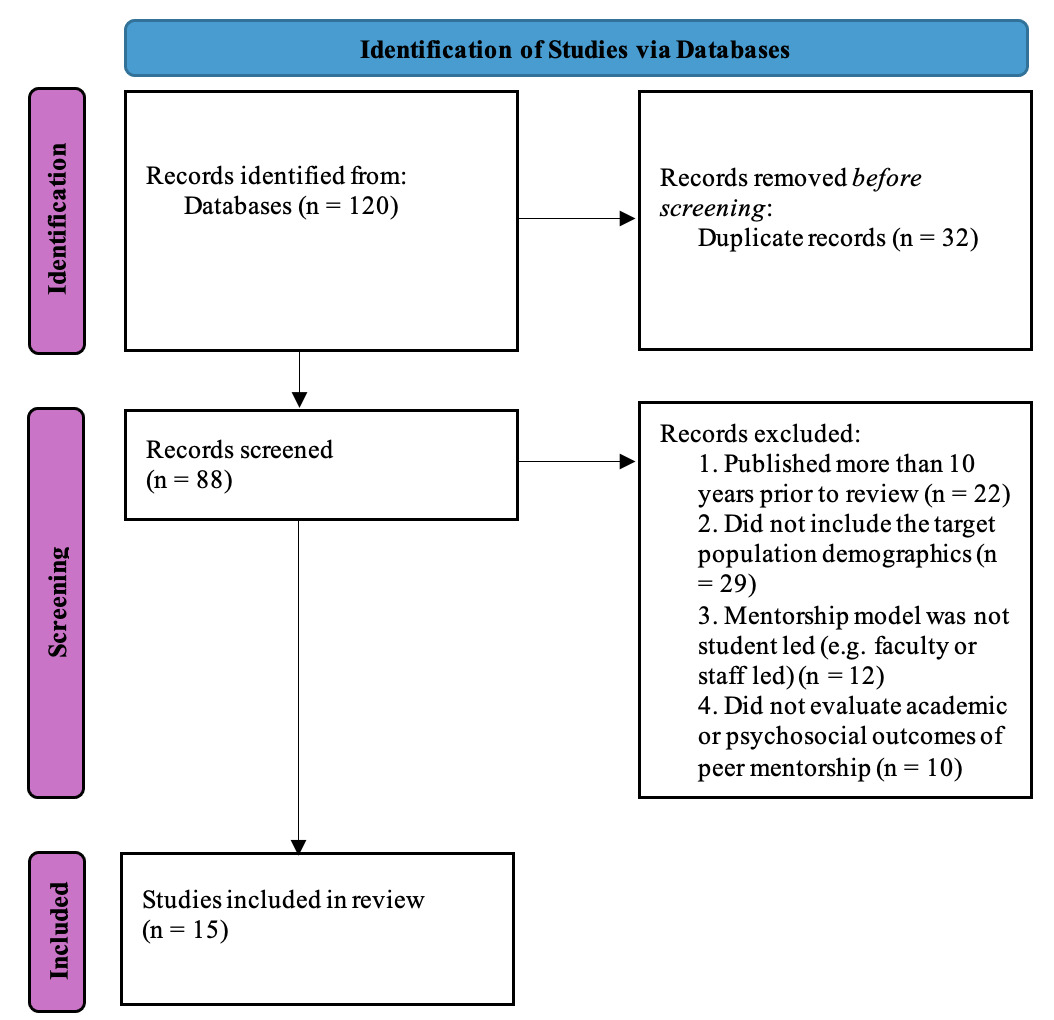
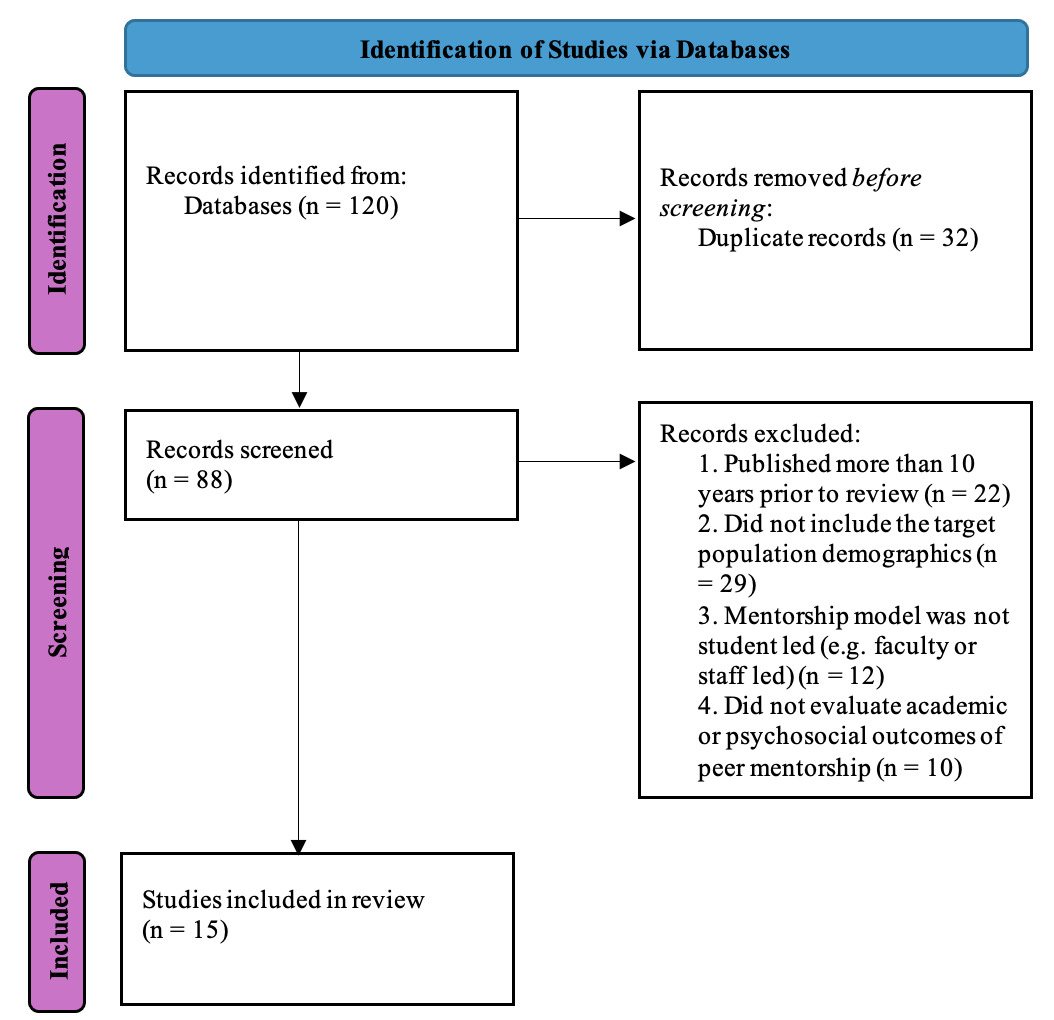
Inclusion criteria were peer-reviewed journal articles published within the past 10 years that examined the academic and psychological benefits of peer mentorship among RRNAs or other graduate and nursing students. Exclusion criteria included studies that did not specifically examine peer mentorship or peer support as a primary intervention, articles centered solely on faculty-led mentorship, and clinical preceptorship without a peer component outcome. Dissertations, conference abstracts, opinion pieces, unpublished or ongoing studies, and non-empirical literature were also excluded. These criteria were applied to ensure relevance, methodological rigor, and alignment with the objectives of the review. After a full-text review of articles, 15 articles were retained for use (see Figure 1).
Methods
Study Design and Participants
This descriptive exploratory study examines the perceived benefits and barriers to peer mentorship among RRNAs within Certified Registered Nurse Anesthesiology (CRNA) educational programs. Through systematic data collection and analysis, this research aims to identify RRNA’s perceptions of peer mentorship structures, determine factors that facilitate or impede effective mentorship, and generate evidence-based recommendations for program enhancement that could improve RRNA outcomes and professional development.
Study participants include RRNAs enrolled in a CRNA program accredited by the Council on Accreditation (COA) of Nurse Anesthesia Educational Programs. Convenience sampling was used to identify participants, and Program Directors from all COA accredited CRNA programs were asked to disseminate the validated survey to their RRNAs. Exclusion criteria included anyone not currently enrolled in a COA-accredited CRNA program and individuals under 18 years of age.
Data Collection Methods
This study employed an investigator-developed survey administered through the Qualtrics platform to current RRNAs enrolled in an accredited CRNA educational program. The survey incorporated conditional branching logic to direct participants through differentiated question pathways based on their status as peer mentors. Specifically, 2 distinct survey versions were programmed: one tailored for RRNAs actively participating in peer mentorship within their CRNA program, and another for RRNAs without peer mentorship. Those with peer mentorship received a survey consisting of 5 demographic questions and 22 multiple-choice, Likert-scale, or open-ended mixed questions. Similarly, those without peer mentorship received a survey consisting of 5 demographic questions and 18 multiple-choice, Likert-scale, or open-ended mixed questions.
Before conducting the study, in the judgment-quantification stage of content validation, a systematic approach of selecting, orienting, and using content experts to establish face and content validity was implemented.10 Two survey researcher content experts collectively scrutinized items for appropriate item construction, clarity, representativeness of concepts, and redundancies in measurement. Decisions to retain or delete items were based on the expert panel’s consensus on the contribution of each item to the measurement domains.
An additional panel of 6 individuals with experience in graduate level education evaluated the survey for content validity. The panel consisted of 3 graduate-level nursing program directors, 2 graduate nursing students, and 1 former graduate nursing student. All 6 participants were practicing healthcare professionals, with 3 specializing as experts in anesthesia. Using convenience sampling, these individuals were recruited to review the proposed survey items and rate each question on a 4-point Likert scale for clarity and relevance to the study purpose. Feedback from the panel was used to refine survey items and strengthen content validity prior to survey administration.
The Lawshe method was used to determine the content validity ratio for each survey question.11 Based on these ratings, the overall content validity index (CVI) was calculated for each instrument. The CVI for the survey targeting individuals with peer mentorship was 0.97, while the CVI for those without peer mentorship was 0.98. Both values exceeded the benchmark ratio of 0.83 required for validation by the 6 experts.12 Feedback from the experts was incorporated to improve survey questions before dissemination.
Data Collection Procedure
The survey was sent to eligible RRNAs through a Qualtrics XM link provided by their Program Directors. Participation was voluntary, and RRNAs could withdraw from the study at any point. All responses were anonymous, with no identifiable information collected. The survey was available for 30 days, and a reminder email was sent to Program Directors 14 days before the deadline.
Data Analysis Plan
Descriptive statistics were used to characterize the study population. Frequencies and percentages were calculated for categorical variables, including age, gender, year in school, and presence or absence of peer mentorship. RRNAs were also stratified by geographical location and AANA region. To assess perceptions of peer mentorship by structure and type, responses were analyzed based on whether participants reported formal, informal, or no mentorship. Parallel questions allowed for comparison across groups. Each group also responded to open-ended questions regarding perceived benefits and barriers to peer mentorship. Qualitative data from open-ended responses were analyzed using Braun and Clarke’s 6-phase thematic analysis: (1) familiarization, (2) coding, (3) theme development, (4) theme review, (5) defining and naming themes, and (6) final reporting.13 This approach facilitated the systematic identification and interpretation of patterns, enabling the study’s aims to be addressed and guiding peer mentorship practices.
Ethical Considerations/Protection of Human Subjects
The study was approved by Northeastern University Institutional Review Board and determined to be exempt from their oversight. Participants were informed that there were no direct risks or benefits associated with their participation, although their input could help improve peer mentorship in CRNA programs. A participant information sheet, including study details and the researcher’s contact information, was available for download or printing. Informed consent was implied by the initiation of the survey, and participants could withdraw at any time.
Results
Sample Population
The study sample consisted of 315 RRNAs across 46 nurse anesthesia programs, representing a 32.4% response rate from the 142 programs surveyed. Most participants were aged 26–28 (n = 93, 29.5%), female (n = 229, 72.7%), and in their first year of training (n = 142, 45.1%). All AANA regions were represented; Region 1 – comprising of the Northeastern United States – contributed to the largest share of respondents. At the time of the survey, 203 RRNAs (64.4%) had begun clinical rotations, while 112 (35.6%) had not. Some form of peer mentorship was reported by 268 RRNAs (85.1%), whereas 47 RRNAs (14.9%) reported none.
Formal versus Informal Peer Mentorship Programs
Among the survey respondents, 27.44% reported participating in a formal peer mentorship program, 30.45% reported having access to informal peer mentorship, and 37.97% reported participating in both formal and informal peer mentorship. Within the group engaged in formal peer mentorship, program structures varied in how mentors were assigned. Specifically, 44.31% of RRNAs indicated that their mentor was assigned based on perceived similarities such as shared goals, interests, and personality traits. In contrast, 13.77% reported that mentor assignments were paired randomly, while 26.95% were unsure how the matching process was determined. An additional 14.97% RRNAs selected “other,” citing various program-specific assignment methods such as pairing mentees with mentors at the same clinical site as well as allowing RRNAs to pair up with a mentee that they had previously formed a connection with (i.e. a work colleague or past classmate). Despite efforts to align mentors and mentees effectively, 12.64% of RRNAs involved in formal mentorship felt they were not well matched with their assigned mentor, highlighting potential areas for improvement in the pairing process. Regarding perceptions of informal mentorship, 67.53% of RRNAs who only participated in informal peer mentorship believed that implementing formal mentorship would be beneficial to their overall educational experience. Conversely, 23.38% did not believe that a formal program would add value, while 15.58% reported feeling unsure about its potential benefits.
Psychosocial and Academic Benefits and Barriers
Overall, RRNAs reported that peer mentorship provided both psychosocial and academic benefits, with formal mentorship generally offering greater perceived support than informal arrangements. As seen in Table 1, mentorship was described as fostering emotional support, confidence, and a sense of belonging, while also clarifying expectations, contextualizing coursework, and reducing stress during academic and clinical transitions. Despite these benefits, some barriers to engagement were also noted. While most RRNAs reported positive experiences, such as no difficulty building trust (88.62%) and comfort communicating with mentors (93.41%), factors such as personal responsibilities (29.89%), lack of communication (21.84%), and incompatibility (8.05%) were cited as limiting participation. Notably, nearly one-third of RRNA’s (31.61%) reported no barriers to mentorship.
Discussion
This descriptive exploratory study demonstrates the value of peer mentorship in nurse anesthesia education. Given the academic intensity and clinical demands of CRNA programs, these findings support the growing evidence that structured peer support enhances RRNAs’ psychosocial well-being and academic performance. Consistent with existing literature in nursing and graduate education, participants strongly indicated that both formal and informal peer mentorship enhanced their academic performance, confidence, and emotional well-being. Mentees gain valuable insights from peers who have navigated similar challenges in coursework and mental health. This support strengthens academic skills through collaborative learning and problem-solving while also promoting resilience and reducing isolation. Trust and empathy within these relationships help RRNAs overcome obstacles and achieve holistic success. Given the high stress and low well-being reported in the RRNA community, peer mentorship can have a particularly meaningful impact on these RRNAs.14
These findings are particularly relevant in the context of nurse anesthesia education, where mentees described mentors as key sources of reassurance and guidance during challenging academic or clinical transitions. Many RRNAs reported that these relationships fostered a psychologically safe environment, encouraging open discussion without fear of judgment, particularly during challenging academic or clinical transitions. Peer mentorship plays a vital role in fostering both academic and psychosocial success by providing a supportive, relatable, and accessible network of guidance.
While both formal and informal mentorship models were associated with academic and psychosocial benefits, formal programs were more often linked to improvements in time management, clinical readiness, and understanding of course expectations. These findings align with research in other graduate health professions, where structured mentorship is associated with higher retention rates, program satisfaction, and academic performance.15 However, the effectiveness of formal programs varied depending on the level of structure and compatibility between mentor-mentee pairs. As represented in Table 2, RRNAs reported positive outcomes such as psychosocial and academic support as well as clinical confidence. They also reported that unclear or random matching processes, limited role definition, and reluctance to initiate contact hindered communication and engagement. Recommendations included improving compatibility through shared interests or clinical placements, providing clearer role expectations, offering mentor training, and scheduling dedicated time for interaction.
Peer mentorship further provides a unique outlet for discussing challenges with someone who shares similar experiences in ways that differ from interactions with friends, family, or faculty.8 Because these relationships occur in a non-hierarchical structure, they foster relatability and mutual understanding, which enhances psychosocial well-being.9 By fostering psychosocial success, peer mentorship also promotes academic success. In clinical education, mentorship enhances progress by improving self-efficacy and reducing stress.16 Increased academic awareness, improved procedural and disciplinary knowledge, enhanced writing and publishing skills, and strengthened research and methodological abilities are all also noted to be anticipated benefits of peer mentorship within graduate level studies.17
Despite its benefits, peer mentorship faces challenges. Role ambiguity, in which participants are uncertain of expectations or boundaries, can limit effectiveness.3 This uncertainty may be regarding the structure of the program or even how to prioritize time and establish relationships. “Interpersonal mismatch” is another common barrier, where the mentor and mentee do not share similar values, personalities, communication preferences, or workstyles.18 Inaccessibility, limited expertise, and different supervisory styles are also significant barriers.18 Cultural competence has also posed problems in mentorship success, with 1 study citing that cultural differences among peers may unintentionally hinder the relationship.3 Lastly, time, distance, and life-style barriers are other notable impingements upon these programs’ success.17
Implications for Future Research
These findings suggest important implications for nurse anesthesia program educators. Peer mentorship should be incorporated as a core component of CRNA education rather than being a RRNA-led initiative. Programs should prioritize compatibility during matching, incorporate RRNA input into pairing criteria, and provide structured support through defined roles, opportunities for feedback, and faculty guidance in navigating the mentor-mentee relationship. Such efforts may maximize the academic and psychosocial value of peer mentorship, ultimately enhancing RRNA satisfaction, well-being, and success in nurse anesthesia programs.
Several limitations should be acknowledged when interpreting this study’s findings. Notably, the study may be affected by recall and self-report biases, which could have shaped participants’ responses. The timing of the survey distribution might have impacted responses due to different program schedules. Comparisons between RRNA’s with and without mentorship experience were also limited because those without mentorship lacked a frame of reference, although many still believed mentorship would be beneficial. Additional factors, such as program format and institutional culture, may have influenced the outcomes. Future research should explore the long-term effects of structured peer mentorship on academic success, well-being, and professional growth. Including mentor perspectives will also contribute to a more complete understanding of these relationships.
Conclusion and Summary
This national study explored the role of peer mentorship in supporting the academic and psychosocial well-being of RRNAs. RRNA responses, supported by existing literature, highlighted numerous benefits of both formal and informal mentorship, including increased confidence, reduced stress, improved time management, and a stronger sense of belonging.
Based on these findings, several recommendations were identified to strengthen mentorship within nurse anesthesia programs: intentional mentor-mentee matching, increased structural support, and greater institutional involvement. RRNAs emphasized that mentorship helped reduce feelings of isolation, eased academic and clinical transitions, and enhanced their confidence in navigating the demands of CRNA education.
Although barriers such as time constraints, interpersonal mismatches, and a lack of program structure still exist, addressing these issues could potentially improve RRNA outcomes. Faculty and program directors should see mentorship as an essential part of RRNA’s success rather than an optional activity. Future research should expand on these findings by examining the long-term effects of structured mentorship and including mentee perspectives to better inform program design and implementation.