Introduction
Teaching a novice nurse anesthetist the skill of direct laryngoscopy (DL) for general endotracheal anesthesia requires both clinical and teaching expertise. Clinical preceptorship in nurse anesthesiology profoundly influences both student learning experiences and preceptor satisfaction,1 and student registered nurse anesthetist (SRNA) training is increasing in rigor and demand. Endotracheal intubation is time-sensitive,2 and failed intubation attempts are common among junior learners.3 Together with SRNAs, clinical educators must quickly and masterfully secure the airway, with little room for error. They must prioritize patient safety while allowing learner participation so the student may develop proficiency with this procedure. Although programs and tools have been developed to support nurse anesthesia educators,4,5 there remains a gap in defining what effective clinical teaching looks like in practice.
When a nurse anesthesia educator and student carry out a clinical task together, the task becomes a focal point for feedback during performance. This feedback-in-practice functions as an educational activity embedded within clinical care.6 The educator supports the student in reflection-in-action, whereby they jointly recognize problematic aspects, articulate and reframe the underlying challenge, and draw out implications for future action.7 However, immediate clinical demands constrain learning and performance goals, and teaching (i.e., student participation with feedback) must align with those realities.
Adding to these teaching challenges, expert anesthetists perform DL by relying on tacit knowledge - knowledge that is acquired through experience and difficult to articulate.8,9 Tacit knowledge is typically conveyed through nuanced, context-dependent interactions and can be conceptualized as a network of if-then or cue-action statements. We previously unpacked the tacit knowledge anesthetists use during challenging mask ventilation and found that experienced anesthetists act adaptively and responsively to nuanced patient cues.10 For example: IF you administer an inadequate dose of induction agent and see abdominal wall movement, THEN you should suspect paroxysmal breathing and administer a higher dose.
We suspected that teaching DL also requires tacit knowledge. Anesthesia educators must use their clinical and teaching experience to focus their attention on patient and student, making subtle adjustments based on cues from both. The lack of clarity surrounding these combined processes highlights the importance of understanding how clinical educators can observe and adapt their teaching actions in real-time. The objective of this study was to elicit the tacit knowledge that anesthesia teachers use to engage in reflection-in-action with students during DL. By systematically outlining how educators respond to student cues, we can not only improve clinical teaching and accelerate the transfer of DL-related knowledge, but also deepen nurse anesthesia educators’ own understanding of their craft.
Materials and Methods
Study Design
We conducted this study using a constructivist qualitative methodology, grounded in our assumption that understanding of clinical teaching is socially constructed through interaction between clinical educators and researchers.11,12 A constructivist paradigm allowed us to recognize the existence of multiple clinical teaching realities shaped by educators’ clinical expertise and teaching philosophy, learners’ competency and actions, environmental characteristics (e.g., patient complexity), and the sociocultural context of the operating room. Given our study’s focus on how clinical educators teach endotracheal intubation to SRNAs, this approach was well-suited to exploring how participants interpret, enact, and construct meaning around teaching a high-stakes psychomotor skill within complex clinical environments.
Core elements of constructivist methodology include: an emphasis on participants’ subjective meanings and lived experiences; recognition of the researcher as an active participant in knowledge construction; reflexivity throughout the research process; inductive, iterative data analysis; and the co-construction of findings through dialogue between researcher and participants.13 To structure our inquiry, we employed the Critical Decision Method (CDM),14 a task-focused interview technique that elicits tacit knowledge from experienced practitioners making decisions under time pressure and uncertainty, like in DL. CDM is widely recognized for uncovering cognitive expertise in medicine and other fields (e.g., military operations, fireground command, engineering)14 but has not been used widely in health care. It prompts interviewees to recall non-routine situations and uses semi-structured probes to explore how they use environmental cues to adjust their typical actions to atypical conditions. CDM assumes that environmental cues are variable, and experts tacitly use their experience to respond adaptively. In this study, the experts were the anesthesia educators, and the environmental cues were SRNA behaviors that signaled a need to adapt teaching strategy.
Research Team
Our interdisciplinary research team included a practicing Certified Registered Nurse Anesthetist (CRNA) who teaches anesthesia students (AD), a senior medical student researcher (AG), a behavioral scientist and physician educator with expertise in researching tacit knowledge (ATC), 2 research assistants (ACorpin, CS), and a pelvic surgeon who performs surgical education research (GS). Data collection was primarily performed by AG, who was trained by AD, ATC, and GS in qualitative methods, including active listening, empathy, and probing. Additionally, we incorporated trustworthiness practices throughout the iterative data collection process by reviewing transcripts as they came in, providing feedback to AG, and analyzing the data together. AD served as the subject matter expert related to teaching SRNAs. All members of the team participated in crafting the interview protocols, evaluating interview/data quality, and adapting the data collection approach.
Setting and Participants
We conducted our study at a multispecialty urban teaching hospital in the Midwestern US that has an SRNA training program. Every surgery in our institution, with very few exceptions, is staffed with a CRNA and an anesthesiologist, actively instructing an SRNA. Participant teachers were either a CRNA or an MD and were included if they had taught ≥ 1,000 intubations to SRNAs. We sampled in 2 stages: initially, we recruited a convenience sample of 6 anesthesia educators through snowballing; subsequently, we purposely recruited participants who might challenge our evolving perceptions or provide more detail on the cues and actions from our initial findings, stopping when we had reached saturation.
Data Collection, Analysis, and Saturation
Data collection and analysis were performed in 2 iterative phases. In the first phase, we conducted semi-structured interviews with 6 participants, eliciting their teaching strategies when DL is time-pressured, and the student is a novice (Appendix 1). The semi-structured interview guide was developed by the team after review of our initial study of how experienced anesthetists respond adaptively to nuanced patient cues during challenging mask ventilation.10 We discussed how teaching DL might similarly depend on nuanced student cues. It was reviewed by 3 investigators with expertise in qualitative research (AD, ATC, and GS). We ensured that the interview questions were clear and aligned with CDM. In place of pilot testing it, we allowed for revisions to the questions depending on how they performed in early interviews.
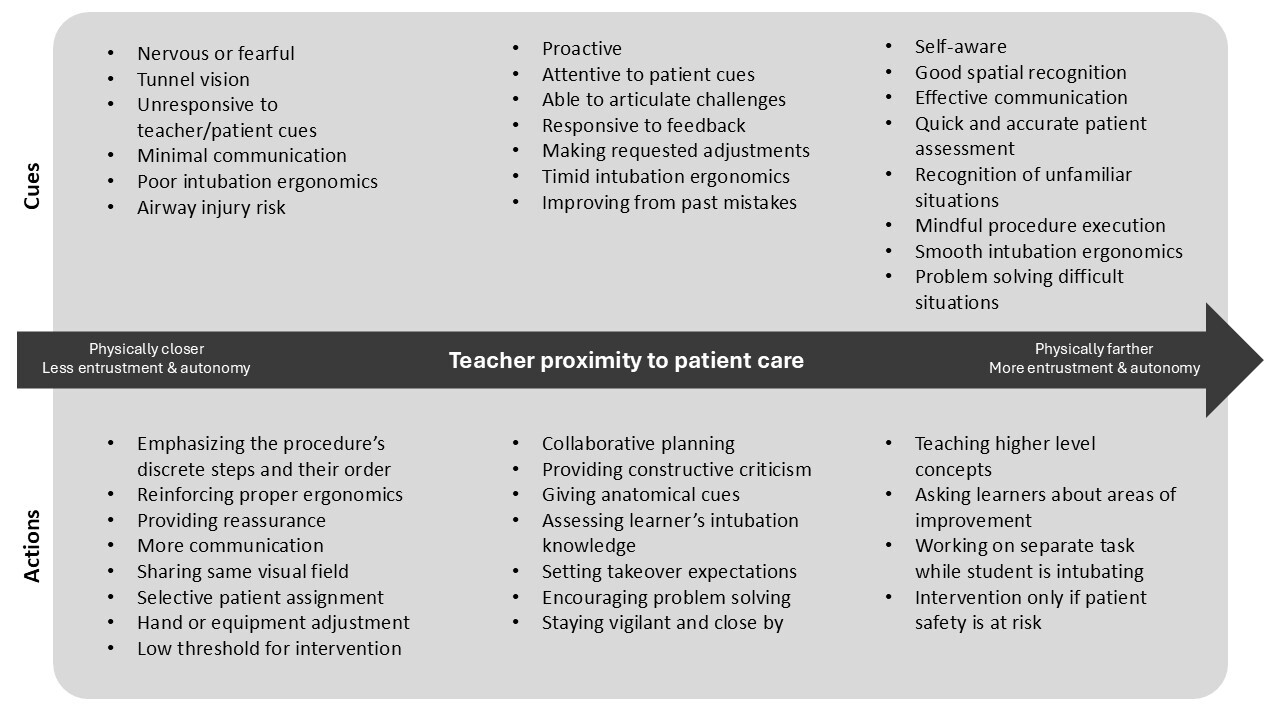
We defined DL as the time from administration of induction medications to the confirmation of end-tidal CO2. In keeping with CDM, each interview began by asking the participant to imagine performing DL with a student who has had 1-4 weeks of clinical training, followed by prompts to elicit how educators adapt their teaching according to student cues (e.g., “What kinds of student actions prompt you to pause and potentially intervene in their handling of the procedure?”). Following the sixth interview, at which point we were approaching data saturation,13,15 we used whiteboard schematics to create 2 summaries of our coded data: 1) a pictorial representation (flowchart) of student cues and educator actions, and 2) a table of higher-order, student-independent teaching principles.
In phase 2, we revised the semi-structured script and interviewed 9 additional participants. We sought to refine the tacit knowledge product we were developing by gathering any cues or teaching strategies that we missed in previous interviews and identifying any dissenting views. The revised interview script (Appendix 2) did not include the prompt to imagine teaching DL to an inexperienced student. Rather, this interview focused on eliciting participants’ reflections on the flowchart and table, asking them to comment, revise, and add to both. Additionally, it included questions linking student cues to teacher actions. After each interview, we revised the flowchart, table, and interview script to be used in the next interview. We reached data saturation12,13 when there were no further changes to our flowchart and table after 15 total interviews.
The student researcher (AG), trained by AD and the research team, conducted all interviews with participants through Zoom. Each interview lasted 30-45 minutes and was audio-recorded and auto-transcribed by Zoom. Interviews were subsequently re-transcribed by AG, de-identifying each participant. Data analysis was performed by identifying student cues and teacher actions from the de-identified transcripts. Two researchers (AG and GS) conducted an initial round of data review to identify these cues and actions and group them, and they were subsequently presented to the research team. It became clear in our process that they could be grouped by entrustment, which helped to develop a working tacit-knowledge framework, which was converted into a flowchart. This flowchart, along with its defined cues and actions, guided subsequent discussions of the data among the whole research team. The process was iterative, incorporating group consensus through constant comparison, and focused on identifying specific cues and actions related to DL instruction, consistent with CDM technique.
Member Checking
We validated our findings through member checking, showing all participants the final version of the flowchart of cues and actions and the table of higher-order teaching principles. We documented their reactions, seeking both supportive and contrasting interpretations. We received responses from 11 participants, who reinforced our findings.
Ethics and Reflexivity
Our team members had diverse backgrounds, and our collaboration reflected an interprofessional approach. To maintain reflexivity, we actively sought each team member’s perspective and kept detailed notes of all meetings to document how our varied experiences shaped the research design and data analysis. GS works with multiple OR team members, including nursing staff, but did not conduct any interviews and only reviewed deidentified transcripts. We followed SRQR guidelines, and our study was approved as exempt by our University Institutional Review Board (IRB# 2091532).
Results
Our study’s participants included 15 clinical educators, including 10 CRNAs and 5 anesthesiologists. Ten participants identified as female and 5 as male. Most had more than 10 years of teaching experience (n = 11), with 3 reporting fewer than 5 years and one reporting 5-10 years. Fourteen participants identified as White and 1 as Asian. Our sample was representative of the CRNA teachers at our institution.
Nurse anesthesia educators in our study reported using intentionality to teach direct laryngoscopy to SRNAs. Their accounts of their teaching included allowing the students to gain valuable experience while simultaneously balancing patient safety. They reported prioritizing an organized, step-by-step teaching routine while remaining vigilant for changes in the patient. As they watched the patient for cues of challenging DL, they also watched the student for cues reflecting more or less need for direction or intervention. They reported being able to respond to those cues in real-time, sometimes in close proximity to both patient and student, and other times maintaining a distance to allow the student more independence.
Students exhibited behaviors that served as cues to vary the extent of educator intervention
Our participants described some student behaviors as “warning signs” (S3) that teacher intervention in patient care is needed, including not listening, not acting, or waiting for instruction. Participants described these students as unresponsive to direction and displaying a lack of action, such as “they’re so tunnel vision that they won’t listen” (S8) and “waiting for me to tell them what to do” (S5). They noted that these students are unable to identify relevant anatomy, despite intently looking at the airway, and might become “frustrated after an attempt or two.” (S13)
Participants described other student behaviors as signaling that they had “gotten some more proficiency in direct laryngoscopy … and [can] take initiative” (S13), yet were far from advanced. Based on such cues, 1 participant recognized that “placing the endotracheal tube in this patient [Mallampati three] is a higher risk than if they were a Mallampati one” (S6). Participants described these students as able to articulate “strategies once we’re in the operating room” (S10). They respond to feedback and make “appropriate corrective actions” (S7) at the teacher’s request. Even though these students may be “timid with sweeping the tongue enough,” (S11) “they’re willing to listen, have done their homework, [and] make appropriate corrective actions” (S7). They also demonstrated a “level of awareness and the desire to improve themselves” (S15) that engendered teachers’ willingness to intervene less.
Participants described some students as showing that DL ergonomics had become second nature. Along with “movements [that] are smooth and not jerky,” they can “clearly articulate…I see the arytenoids…and corniculate cartilages” (S8). Participants also attributed their smooth DL to their good “spatial recognition,” such as having a “sense whether or not they’re too deep with a blade” (S7). These students were described as distinguishing themselves as “mindful [as they] go through the [procedure] steps” (S6), as having “good communication…and willingness to be taught” (S3). Participants noted that these students use the physical and critical thinking skills they gained during their clinical training, and they “know how to troubleshoot” (S10) and problem-solve difficult situations. Along with these problem-solving skills comes self-awareness, as “they are able to recognize when they’re in situations that they haven’t seen” (S10) and “recognize what [their] limitations are” (S14).
Educators described responding to student cues by adapting their proximity to patient care
Based on verbal, physical, and situational cues, our participants reported adjusting their physical distance to the student and the patient, staying closer when they believed intervention was required and allowing more distance when they judged the need for intervention to be less likely (Table 1, Figure 1). This proximity was “individualized per student,” and their “responsive[ness]” (S9). For instance, participants who observed a “student whose [hand] movements say…they are less skilled” would be “quicker to intervene.” If a student had tunnel vision and was focusing too much on a small area, the teacher might “grab their shoulder and kind of pull them back up and say, ‘you really need to see the whole picture’” (S8). A student exhibiting poor ergonomics, such as “wrist is locked” (S3), might be met with physical actions aimed at their technique and ergonomics, such as “I’ll step in try and correct them, try and hold their hand” (S3). For the silent student, participants said they would “over-communicate … to kind of provide some feedback” (S10), including emphasizing the procedure’s discrete steps and their order, starting with “grab the laryngoscope scope in your left hand … then … take your right hand and scissor the mouth open” (S8). Participants reported selecting patients for nervous students who did not require rapid care, and they provided these students with continual reassurance, telling them: “there’s no pressure to intubate in a hurry.” (S3) Still, the teacher maintained a low threshold for intervention: “I may step in sooner than later.” (S15)
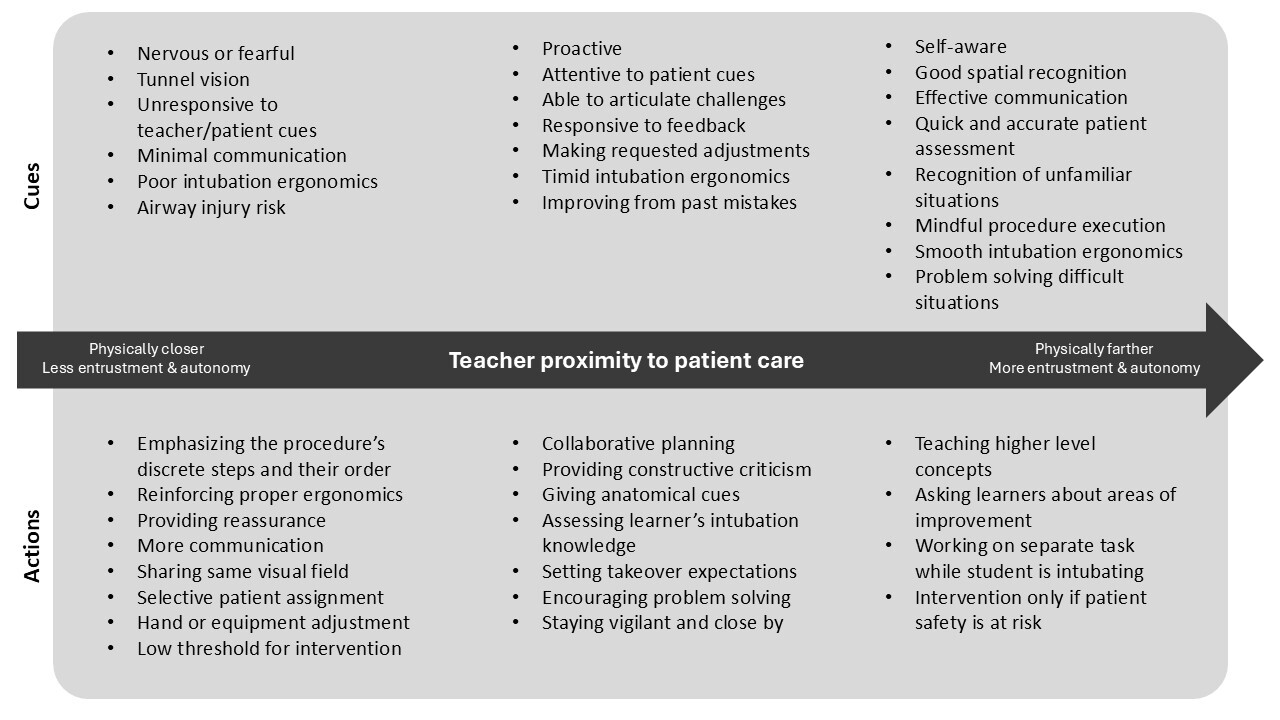
Participants reported using less direct intraoperative teaching for students whose behaviors cued emerging clinical capability, allowing graded independence instead, which still involved remaining “real close to them… directing a lot early on” (S14) with targeted feedback after the DL. If a participant recognized that their student had a basic understanding of the anatomy, for instance, their teaching involved more advanced strategies such as “reminders…of how to…get a more direct view of the… glottis” (S4). Participants described planning DL in a “collaborative” (S15) way with these students, correcting only if the plan “just didn’t make sense” (S15), and “set(ting) takeover expectations” (S6). Promoting students’ independence required “helping them problem-solve a lot or giving them ideas” (S15).
Participants reported allowing students whose behaviors reflected advanced capability to have the greatest autonomy and distance from the teacher. As these students performed DL, participants avoided intervention “as long as the patient is safe” (S2), going so far as to work on separate tasks, such as “signing the chart” (S15) or “start[ing] second IVs” (S14). Participants also were able to “teach higher level concepts” to these students because they “could do the basic steps” (S6). For instance, in response to students’ increased self-awareness, participants offered suggestions for areas of further advancement: “what do you think went well” and “you could have done this better” (S15).
Educators also described employing student-independent instructional techniques to enhance SRNA learning and maintain patient safety
Participants also reported maintaining teaching techniques to enhance learning and maintain patient safety, regardless of student behaviors (Table 2). These educators actively maintained a calm, productive, and positive environment, for example, ensuring only that 1 instructor was present at a time to avoid “overwhelming the student” (S11) with “overstimulation of things they have to process” (S2). They organized the learning and work environment to facilitate the step-by-step technique. This included emphasizing the importance of ergonomics, ensuring that students have “a basic summary of…basic mechanics of…an intubation” (S2) and remain “consistent about everything” (S13). They described balancing student-centered teaching and patient-centered care based on “see(ing) what they [the student] can and cannot do, and then I change my approach” (S12) and intervening if “the patient [is] decompensating at all” (S2). Finally, our participants were committed to facilitating students’ path to independence, including encouraging self-reflection at the end of each instructional period to ensure students “are mindful of the steps” (S6).
Member Checking
The 11 participants who participated in member checking generally resonated with our findings. Supportive comments included “When you’re specifically talking about clinical teaching… a tactile skill or critical thinking or situational awareness, all of those things are challenging or unique to teach an individual, so I believe this model translates.” Suggestions were made to add to the flowchart more language about patients with high acuity, including the possibility of including a less experienced student in their care and the need for increased communication between educator and student.
Discussion
Our study unpacked experienced nurse anesthesia educators’ tacit knowledge for teaching DL, illuminating how they manage the risk of involving students in clinical practice. We found that educators respond to students’ behaviors and adjust their teaching actions accordingly by modifying their proximity to patient care. These findings align with studies examining how educators supervise learning physicians by adjusting their proximity to patient care, knowing when to step in and when to let go.16–18 Our findings also mirror those from our previous study of experienced anesthetists performing challenging, non-routine mask ventilation.10 Those clinicians maintained a heightened awareness of auditory, visual, and tactile cues to adjust their technique and keep the patient safe. We suspect the teachers in our study similarly rely on their senses to adjust their approach to involving students in patient care.
Our findings have implications for teaching all anesthesia learners, including SRNAs and anesthesia residents by addressing an important gap: although formal educational models have been developed,4,5 less is known about what effective SRNA teaching looks like in real clinical practice. Our study advances this understanding by demonstrating how anesthesia educators conduct real-time needs assessments while balancing learner development and patient safety. We recommend that future clinical teaching models and faculty development programs build upon the effective strategies educators are already using in practice.
Although the flowchart depicted in Figure 1 is not meant to be a student assessment tool, it reflects how clinical educators respond to learners’ behavior by allowing a gradual deepening of participation until competency and independence are reached.16–18 This figure and our findings about general teaching strategies may be particularly relevant for the new nurse anesthesia educator. Investigating tacit knowledge for teaching provides anesthesia educators with an opportunity to reflect on their teaching, and it facilitates vicarious learning via knowledge sharing. It also has the potential to encourage a more standardized approach to teaching high-stakes clinical skills.
Our findings also reinforce that learning through clinical work is a collaborative activity. We know that implicit and informal learning routinely occurs in the clinical setting, typically in response to complex, unplanned situations; however, this process becomes most beneficial when clinical team members remain reflective and actively engaged.19,20 Our previous work on surgical education highlights this collaboration between clinical educators and learners. Surgical attendings in that study were directly observed performing minute-by-minute needs assessments of the student, tied to specific surgical actions, and responded to each one individually.21 This process of reflection-in-action, which accomplishes teaching, learning, and patient care simultaneously, is understudied,6 and micro-level analyses like the present study could be used to improve teaching and reduce time to competency. Beyond responding to cues, clinical educators impart tacit knowledge for clinical task performance via a multifaceted process of modeling and feedback that is both dynamic and context-dependent.22
Our study’s strengths include our iterative process of eliciting tacit knowledge from experienced nurse anesthesia educators using the well-established technique of CDM. Use of the CDM model enhances uncovering the knowledge basis of anesthesia educators’ judgment and decision-making; it is also particularly effective for characterizing how tacit knowledge is employed in a time-pressured, uncertain situation, such as leading a novice through DL. Our 2-phase approach allowed us to elicit more detailed information regarding specific cues and actions that comprise reflection-in-action for teaching DL while managing patient safety. Although our analysis did not cover teaching video laryngoscopy or other ways of securing an airway, they can be used to help teachers articulate critical elements such as force, position of the laryngoscope tip relative to the vocal cords, and final position of the tube in the larynx.23–25
Limitations include a sample of only 15 educators from a single institution in the Midwestern US. This sample size is not unusual for qualitative studies that require in-depth interviews; however, our sample had limited demographic diversity, which requires caution when extrapolating our findings to different settings. It would be beneficial to explore, for instance, how educator-student social dynamics related to non-homogeneous social identities (e.g., gender, nationality) influence educators’ detection and use of student behavioral cues. In addition, our sample included some junior clinical educators, who may not yet have acquired tacit knowledge for teaching DL. Future research should compare tacit knowledge elicitation findings between junior and more experienced anesthesia educators. Our findings were based on interviewees’ perspectives, which introduced bias. Future research might seek other perspectives (e.g., learners’). Finally, our analytic approach captured only what participants could articulate, even though tacit knowledge is often inherently inarticulable.26 Direct observation may therefore uncover additional tacit knowledge not accessible through self-report.
Conclusion
Our findings highlight the adaptive strategies that experienced nurse anesthesia educators use to teach DL to SRNAs. By adapting their physical proximity to the student and patient care based on the students’ behavioral cues, these educators foster both technical competence and patient safety. This reflection-in-action approach mirrors adaptive teaching practices observed in other clinical settings and likely characterizes the instruction of other anesthesiology skills. As nurse anesthesia education continues to evolve - incorporating innovations such as VL and blended learning models - understanding and supporting experienced teaching behaviors will be essential for preparing the next generation of educators.